Sports / U.S. model
2025 Porsche 911 Review
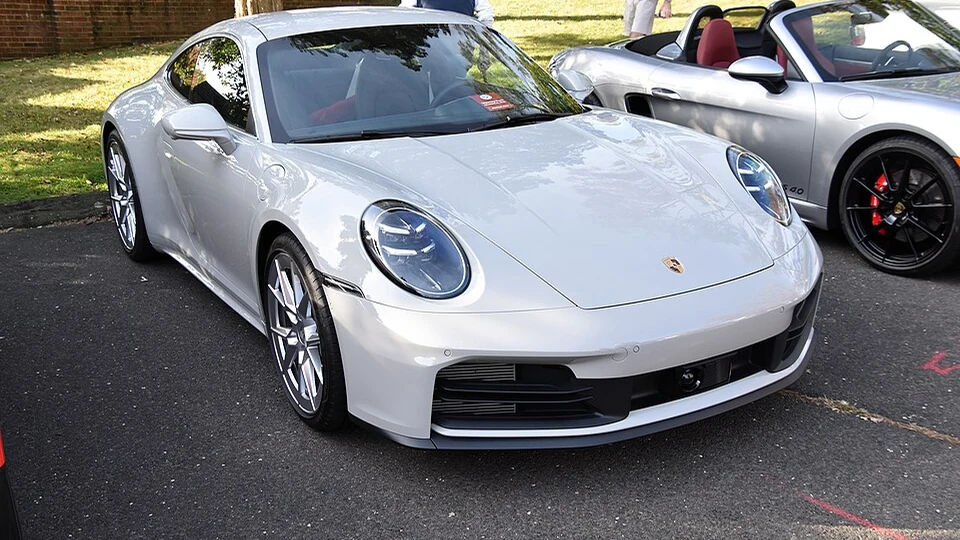
The 2025 911 Carrera brings enough performance to stand on its own, while the GTS takes the range in a new direction with its electric turbo and hybrid system.
Specifications
| Body Style | Rear-engine sports coupe |
|---|---|
| Engine / Powertrain | 3.0-liter twin-turbo flat-six (Carrera) |
| Horsepower | 388 hp (Carrera); 473 hp (Carrera S); 532 hp (GTS system) |
| Torque | 331 lb-ft (Carrera) |
| Fuel Economy | 18 city / 25 highway / 21 combined mpg (Carrera) |
| Transmission | 8-speed PDK dual-clutch automatic |
| Drivetrain | RWD (Carrera); AWD available in 4 GTS |
| Seating | 2 standard in Carrera coupe; rear seats available |
| Cargo Space | 4.8 cu ft (Carrera front trunk) |
| Starting MSRP | $120,100 (Carrera coupe, before destination) |
Overview
Porsche refreshed the 911 for 2025 and used the occasion to bring in a genuinely different powertrain for the Carrera GTS. The standard Carrera stays with the twin-turbo 3.0-liter flat-six familiar to previous buyers. The Carrera S moves power and braking specifications upward, and the GTS introduces a hybrid system designed around performance. All three come with Porsche's PDK gearbox. Other branches of the 911 range, including the Turbo and GT models, have different engineering priorities and price points.
The basic Carrera is useful as the first test drive because it shows how the cabin, rear-engine proportions and controls work at everyday speeds. The difference between that experience and a quicker variant is a more useful starting point than an options list.
Performance & Fuel Economy
The 388-hp Carrera sends power to the rear wheels through an eight-speed dual-clutch transmission. The EPA lists 21 mpg combined. Porsche's Carrera S uses a stronger tune and associated equipment, bringing 473 horsepower. The 532-hp GTS pairs a 3.6-liter flat-six with an electric exhaust-gas turbocharger and a motor integrated with the PDK transmission. That changes how the GTS produces its power and fills out the performance range between the standard Carrera and the more specialized 911s.
You do not charge the GTS at home. It is reasonable to shop on the engine response, equipment and total cost you want instead of treating the extra hardware as a savings decision. A Carrera 4 GTS adds all-wheel drive for buyers who need it.
Interior, Comfort & Technology
The 2025 interior puts a curved digital instrument cluster ahead of the driver, replacing the earlier partly analog arrangement. The cockpit retains useful controls near the driver and the passenger sits close enough to share screen or navigation tasks. The driving position is low, so try getting in where there is only enough space to open the door partway. This reveals more about garage fit than a width measurement on its own.
There are 4.8 cubic feet in the front trunk on the Carrera. A small number of deliberately shaped bags fit better than a rigid oversized case. Porsche includes two front seats as standard in the coupe and offers rear seats as an option.
Safety & Driver Assistance
Check the list of assistance systems when comparing individual 911s, because options can make two vehicles of the same model quite different. Parking sensors and camera views matter on a car whose corners are difficult to see directly. Adaptive highway equipment can be useful for a daily commuter, where the same car may spend much more time on routine roads than in high-speed conditions.
The first stop on a garage test should be a ramp or angled approach, if one is typical for where you drive. Porsche offers additional front-end assistance hardware on qualifying builds. Find out exactly what comes with a used car by inspecting its factory options documentation.
Verdict: Who Should Buy It
The Carrera is the clean choice for regular road use. Move to the Carrera S if its power, brakes and option choices answer a particular preference. Choose the GTS if you want its substantially different drivetrain and setup. It is a sizable price increase and should be compared in conditions where those changes matter.
Body shape, seats and wheel sizes all change how a 911 fits into the week. If the rear seating or front cargo space is essential, verify those before picking performance options. A deliberately ordered base 911 can be more enjoyable on the roads you know than a higher grade that asks you to compromise where you park, carry luggage or travel with someone else.
Pros and cons
Pros
- Strong starting power and useful everyday cockpit
- Distinct powertrain choices across the Carrera range
- Options allow a deliberate street or performance build
Cons
- Small front luggage compartment and optional rear seats
- Most personalization adds substantial cost
- No manual in the Carrera, Carrera S or GTS builds covered
Trim levels and pricing
| Trim | U.S. MSRP | Key equipment |
|---|---|---|
| Carrera Coupe | $120,100 | 388-hp twin-turbo flat-six and rear-wheel drive |
| Carrera S Coupe | $146,400 | 473 hp with upgraded performance hardware |
| Carrera GTS Coupe | $164,900 | 532-hp hybrid flat-six system and rear-wheel drive |
Frequently asked questions
Does the Carrera GTS need to be plugged in?
No. Porsche's T-Hybrid is a self-contained performance system with no plug-in routine.
What is the output of the regular 911 Carrera?
Porsche's U.S. 2025 Carrera is rated at 388 horsepower.
Are rear seats included in the base coupe?
Porsche lists a two-seat layout as standard and makes the rear seat assembly optional.