Electric / U.S. model
2025 Porsche Taycan Review
Porsche's 2025 Taycan update brings substantive gains in charging and range. The rear-drive sedan with the larger battery is a particularly telling alternative to the faster AWD versions.
Specifications
| Body Style | Electric sports sedan |
|---|---|
| Powertrain | Single or dual electric motors |
| Horsepower | 402 hp with launch control, base sedan and standard battery |
| EPA Range | 274 miles, base battery; 318 miles, base sedan with Battery Plus |
| Transmission | Two-speed rear transmission |
| Drivetrain | RWD or AWD |
| Seating | 4 standard; optional rear center seat on applicable models |
| Cargo Space | 14.3 cu ft rear trunk, base sedan |
| DC Fast Charging | Up to 320 kW in eligible configurations and conditions |
| Starting MSRP | $99,400 |
Overview
The 2025 Taycan is still an expensive electric sports sedan, but the update makes it substantially easier to use on long drives. Consider the base rear-drive car: it has a 274-mile EPA rating with the standard battery and is rated for 318 miles with Performance Battery Plus. A shopper who assumed that more than 300 miles required the fastest, most expensive version should revisit that assumption.
Porsche also sells Taycan body styles and high-performance derivatives beyond the original four sedans shown in the trim table. This review is centered on the everyday decision between the base Taycan and 4S. Both preserve the low seating and long wheelbase that define the car. The differences in driven wheels, equipment prices and range are more useful to most owners than headline figures for the range-topping variants.
Performance and Charging
The update increases battery capacity and revises the powertrain. The standard battery is 89.0 kWh gross, and Performance Battery Plus raises that to 105.0 kWh gross. The rear motor uses a two-speed transmission, an unusual detail among electric sedans. The 4S adds front electric drive, which puts more power and traction into the performance calculation while adding weight and cost.
Using a suitable 800-volt DC charger, an eligible Taycan configuration can accept up to 320 kW under favorable conditions. Porsche estimates 18 minutes from 10 to 80 percent in the applicable setup. It is worth preconditioning the pack and checking charger compatibility for your route. A station that is power-limited or shared with another car can make the same stop look very different.
Interior and Technology
The interior gives the driver a low position and a dedicated instrument display, with a primary center screen and an optional passenger display. Porsche revised its interface and standard equipment for 2025, including a heated steering wheel and wireless charging tray. Try the seating position and primary controls before shopping the option list. The car makes the most sense when you enjoy the space directly around the driver.
The sedan's approximately 14.3-cubic-foot rear trunk has a smaller opening than a hatchback, and a front compartment adds somewhere to leave charging equipment. A household used to carrying oversized cases should compare the Cross Turismo's rear opening. Also verify the rear seating setup: standard four-seat configurations and optional center seating have different implications if three passengers regularly sit in the back.
Safety and Driver Assistance
Lane Change Assist is among the added standard equipment for the 2025 update. More advanced support and parking features depend on the car's original build. Two otherwise similar Taycans can have very different options, so ask for the build sheet before assuming that a vehicle listed as well-equipped includes the cruise or camera features you expect.
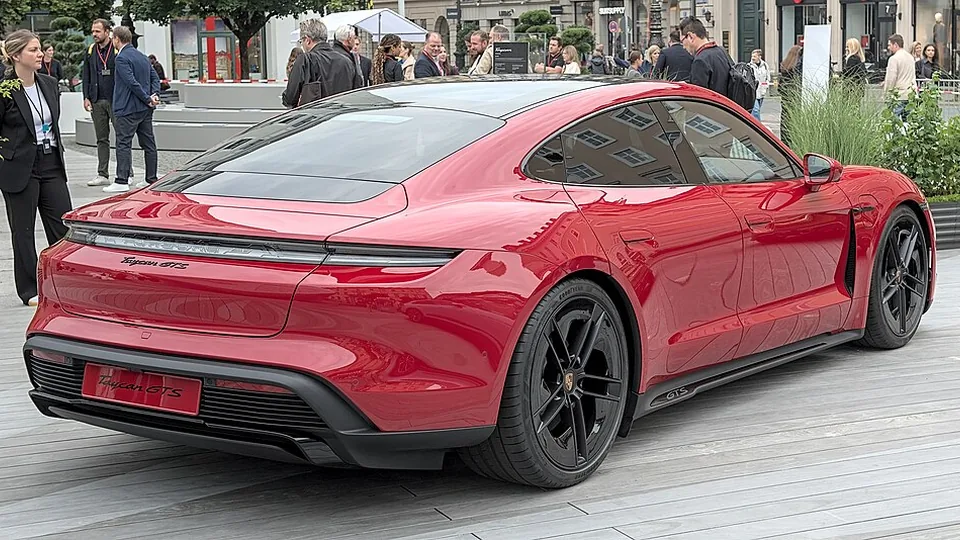
The tapered rear roof and wide stance are obvious at a curb. It is worth trying a low-speed garage turn, watching the camera coverage and working out whether the doors are easy to open in your usual space. If the car will be driven in winter, factor in tires and wheel fitment along with AWD. The drive system cannot make summer performance tires suitable in freezing conditions.
Verdict: Who Should Buy It
The base Taycan with Performance Battery Plus suits someone who wants the driving position and charging hardware but values a longer range more than extra acceleration. The 4S offers a reasonable upgrade for driving in variable conditions or for someone who wants AWD. Turbo and Turbo S push the original sedan price ladder dramatically higher, especially after selecting optional equipment.
Shop a documented used build as carefully as a new order. Review battery and equipment details, look for a charging setup that matches your main route, and confirm the car's rated range with its wheels. A buyer prioritizing rear room and value will find less expensive EVs. The Taycan makes its strongest case as a sports sedan whose charging and range can now support frequent longer trips.
Pros and cons
Pros
- Available 318-mile EPA range for rear-drive sedan
- Fast DC charging in eligible configurations
- Low driving position and distinct two-speed rear drive
Cons
- High entry and option prices
- Sedan trunk is less versatile than a liftback
- Published peak charging speed needs compatible equipment
Trim levels and pricing
| Trim | U.S. MSRP | Key equipment |
|---|---|---|
| Taycan | $99,400 | Rear-wheel drive and optional Performance Battery Plus |
| Taycan 4S | $118,500 | Dual-motor all-wheel drive |
| Taycan Turbo | $173,600 | Higher-output AWD and upgraded standard equipment |
| Taycan Turbo S | $209,000 | Highest-priced of the four original launch sedan configurations shown |
Frequently asked questions
Which 2025 Taycan reaches 318 miles?
The rear-wheel-drive Taycan sedan with the optional Performance Battery Plus is rated for 318 EPA miles.
Does every 2025 Taycan charge at 320 kW?
That is a peak for suitable configurations and conditions on compatible equipment. It is not a constant or guaranteed charging rate.
Is the 2025 Taycan 4S all-wheel drive?
Yes. The 4S adds a motor at the front axle, while the base Taycan sedan shown is rear-wheel drive.