Sedans / U.S. model
2025 Toyota Camry Review
The ninth-generation Camry makes hybrid power standard and still leaves room in the budget for available AWD. The LE has the strongest fuel economy case.
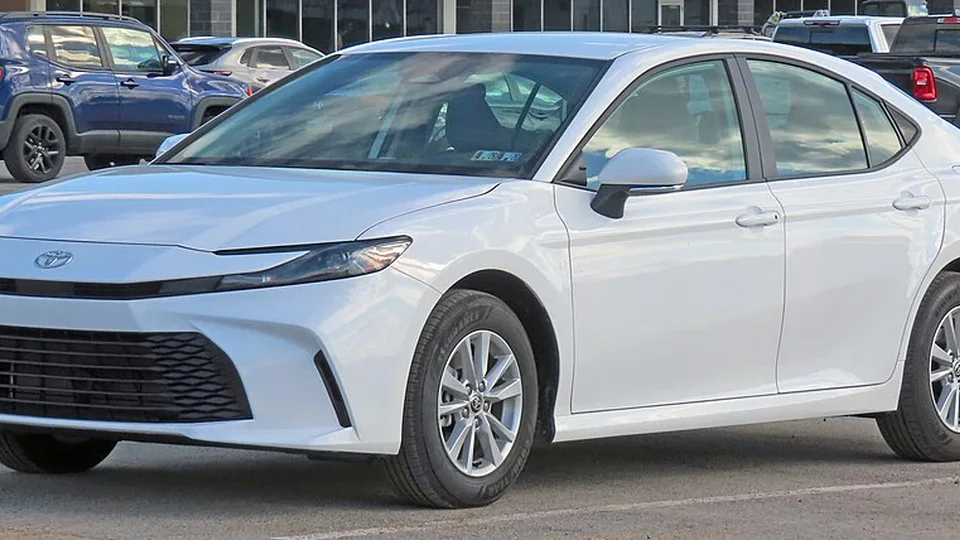
Specifications
| Body Style | Midsize sedan |
|---|---|
| Engine / Powertrain | 2.5-liter inline-four and Toyota hybrid system |
| Horsepower | 225 net hp FWD; 232 net hp AWD |
| Fuel Economy | 53 city / 50 highway / 51 combined mpg (LE FWD) |
| Transmission | Electronic continuously variable transmission |
| Drivetrain | FWD or electronic on-demand AWD |
| Seating | 5 |
| Cargo Space | 15.1 cu ft trunk |
| Starting MSRP | $28,400 (launch LE FWD, before destination) |
Overview
Toyota reorganized the Camry around one powertrain idea for 2025. The U.S. sedan is hybrid-only, including the least expensive LE, while the ninth-generation body brings updated styling and more modern screens. Every version can be shopped in front-wheel-drive or electronic on-demand all-wheel-drive form. Choosing an economical sedan no longer requires a separate hybrid trim with different base equipment.
The most interesting choice is the LE. Its small wheels and economy-oriented specification give it the highest published mileage in the lineup. The SE and XSE use a sportier setup, while XLE aims for a quieter kind of upgrade with more comfort and infotainment features. Shop the options by their effect on long daily drives.
Performance & Fuel Economy
Toyota pairs its 2.5-liter four-cylinder engine with an electric drive system, publishing 225 net horsepower for front-drive models and 232 for AWD. The AWD system uses an additional drive motor at the rear axle. It is optional rather than tied to a luxury grade, which is useful to shoppers who want an efficient car for a hilly or snowy area.
The front-drive LE earns an EPA rating of 51 mpg combined; many pricier front-drive grades are rated at 47. That difference can matter to a commuter who drives a large number of miles. Gas and electric power blend continuously, and the Camry is a regular hybrid, so its electric operation does not depend on an external charge.
Interior, Comfort & Technology
The trunk measures 15.1 cubic feet. A regular trunk opening and shorter load height make sense for groceries, luggage and things that can remain hidden under a closed lid. Try the opening with large gear, since a bulky box may be easier to load through a hatch even when two vehicles have comparable cargo volume.
The LE's standard touchscreen supports wireless Apple CarPlay and Android Auto. Higher trims give you more screen space and additional upholstery or comfort features, while all have the broad proportions of a traditional midsize sedan. Take one short drive with the sun on the screen, and examine the view across the A-pillar before assuming a larger infotainment display will be the most valuable upgrade.
Safety & Driver Assistance
Toyota includes Safety Sense 3.0 across the lineup, along with blind-spot monitoring and rear cross-traffic alert. Toyota's system combines adaptive cruise, lane assistance and a pre-collision feature with other support functions. If you spend hours each week in congested traffic, learn how the gap control takes effect on the model you buy. A glance at a spec sheet is unlikely to show how obvious the current setting is from the driver's seat.
Selected upper-grade packages offer additional assistance and a surround-view monitor. Before paying for it, check the rear camera and mirrors in the kind of parking space you use daily. A familiar narrow driveway can provide a clearer measure of value than a feature count.
Verdict: Who Should Buy It
The 2025 Camry LE FWD is particularly easy to recommend for a high-mileage commuter. Its hybrid system, safety suite and modest base MSRP give the entry model enough substance to stand on its own. The SE is worth trying if you want the way its seats and suspension are set up. Choose the XLE for cabin amenities or an XSE if you want the richer trim along with the sport-oriented specification.
AWD should come down to your route and expected weather. Get a comparable quote, including destination and local fees, before pricing other extras. The Camry is an effective alternative to buying a taller vehicle for a daily trip that mostly needs four doors, a useful trunk and a high fuel-economy rating.
Pros and cons
Pros
- Strong 51-mpg combined EPA rating for the LE FWD
- Same hybrid powertrain family across all grades
- AWD option is available regardless of trim level
Cons
- Upper grades give up some fuel economy
- Sedan trunk opening limits very bulky loads
- No conventional gas-only or V6 option
Trim levels and pricing
| Trim | U.S. MSRP | Key equipment |
|---|---|---|
| LE FWD | $28,400 | Highest-rated Camry for fuel economy and standard hybrid power |
| SE FWD | $30,700 | Sport-oriented styling and suspension specification |
| XLE FWD | $33,400 | Comfort-oriented premium features and a larger screen |
| XSE FWD | $34,600 | Sport-grade setup with additional cabin equipment |
Frequently asked questions
Is every 2025 Camry a hybrid?
Yes. Every U.S. 2025 Camry combines a 2.5-liter gasoline engine with Toyota's hybrid drive.
Which Camry is rated at 51 mpg combined?
The LE with front-wheel drive. Front-drive SE, XLE and XSE have lower published ratings.
Is Camry AWD a plug-in system?
No. An on-demand rear electric motor supplements the regular hybrid system. There is no external charging connection.